25 Cozy Bedroom Ideas for Small Apartments That Feel Bigger
Make a small apartment bedroom feel larger and cozier with 25 ideas for light, layout, textiles, and storage.
A small apartment bedroom does not need to feel like a compromise. With the right scale, light, and editing, compact rooms can feel intimate rather than cramped — and surprisingly spacious.
This guide is for renters and owners who want a bedroom that photographs beautifully and supports real sleep. The ideas below focus on spatial tricks that change how a room is experienced, not on buying more furniture. For a fuller foundation on restful styling, see our guide to creating a calm bedroom sanctuary. For lamps, sconces, and a nighttime lighting setup, see 15 bedroom lighting ideas that feel cozy and expensive. If your challenge is the whole footprint, pair this with small apartment living room ideas.
1. Hang curtains near the ceiling
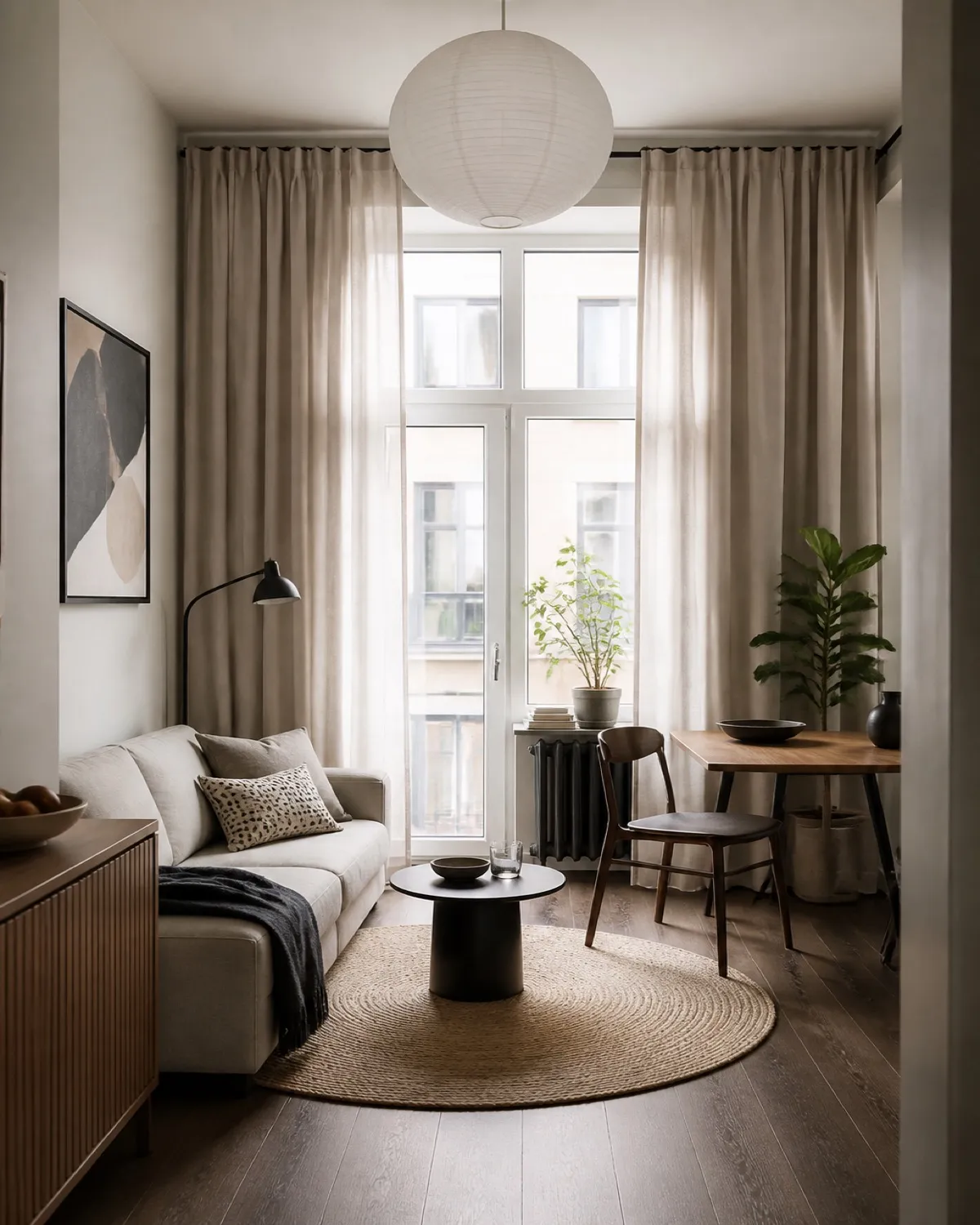
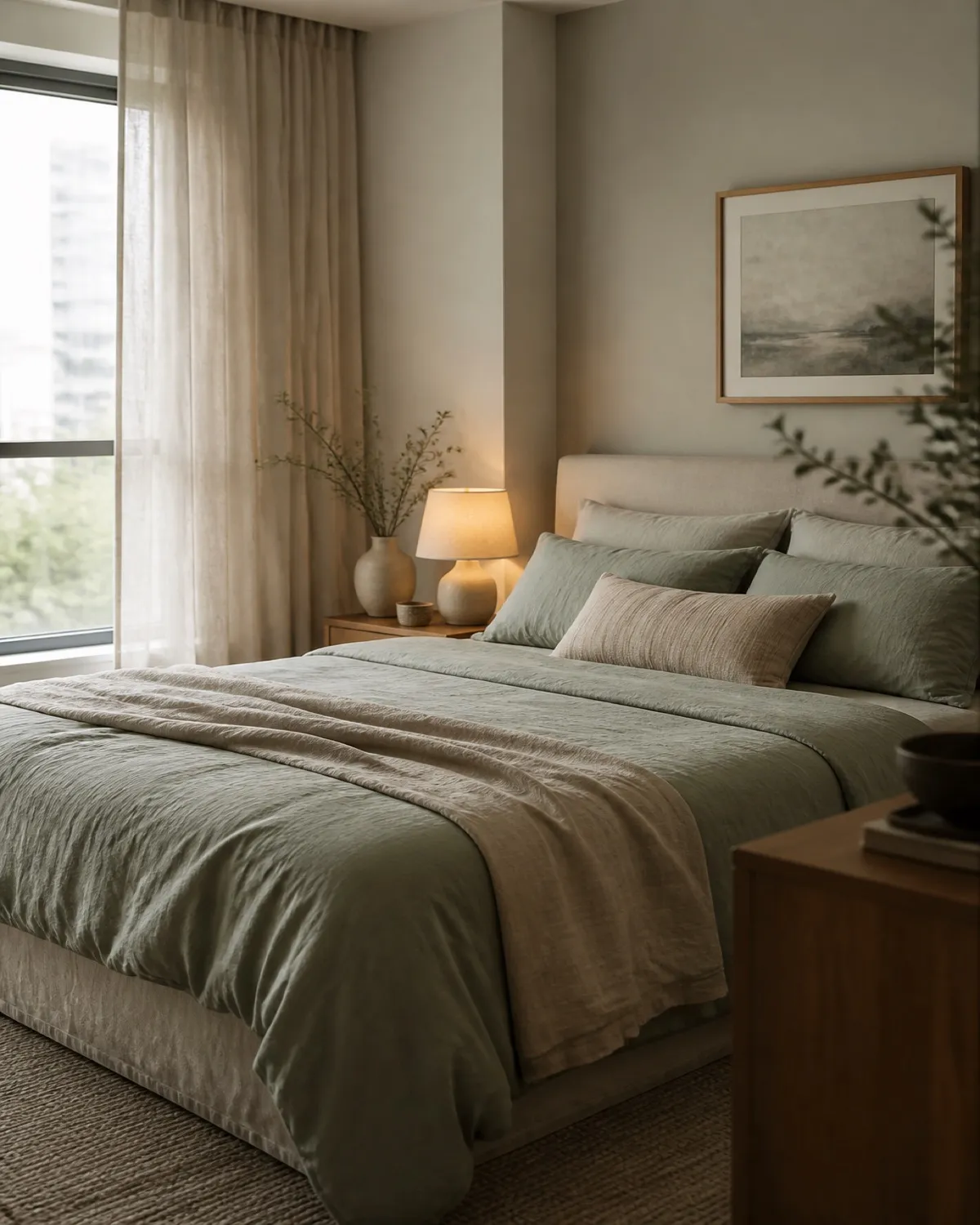
In a low or compact room, rods mounted just below the ceiling draw the eye upward. Let fabric skim or lightly kiss the floor. Even sheer panels create a vertical “column” of softness that makes walls read taller than they are.
Nestlyra tip: Choose a rod that extends 6–12 inches past the window frame on each side so glass looks larger when curtains are open.
2. Choose a bed with visible legs
Boxy platform frames that sit flush to the floor can make a small bedroom feel heavier. A frame with tapered or open legs reveals floor underneath — your brain reads that as more square footage.
If you love a grounded look, keep the mattress low but leave negative space under the footboard or headboard sides.
3. Use one large rug, not several small ones
Scattered mats chop a room into visual leftovers. One generously sized rug under the bed (ideally extending at least 18–24 inches beyond the sides) unifies the sleeping zone and softens hard flooring without clutter.
In studios, let the bedroom rug stop just short of a living-area rug so each zone keeps its own “island.”
A 6-by-9 abstract grey rug is a practical field for that job in many small apartments: large enough to catch both sides of a queen, quiet enough not to compete with bedding.
4. Paint (or style) walls a single quiet field
High-contrast accent walls can work in large rooms; in small bedrooms they often slice the volume. A continuous soft field — warm white, stone, misty sage, or clay — lets corners dissolve. Depth then comes from textiles and lighting, not paint drama.
If your lease forbids paint, achieve continuity with matching bedding, curtains, and a large textile headboard in related tones.
5. Swap overhead glare for layered glow
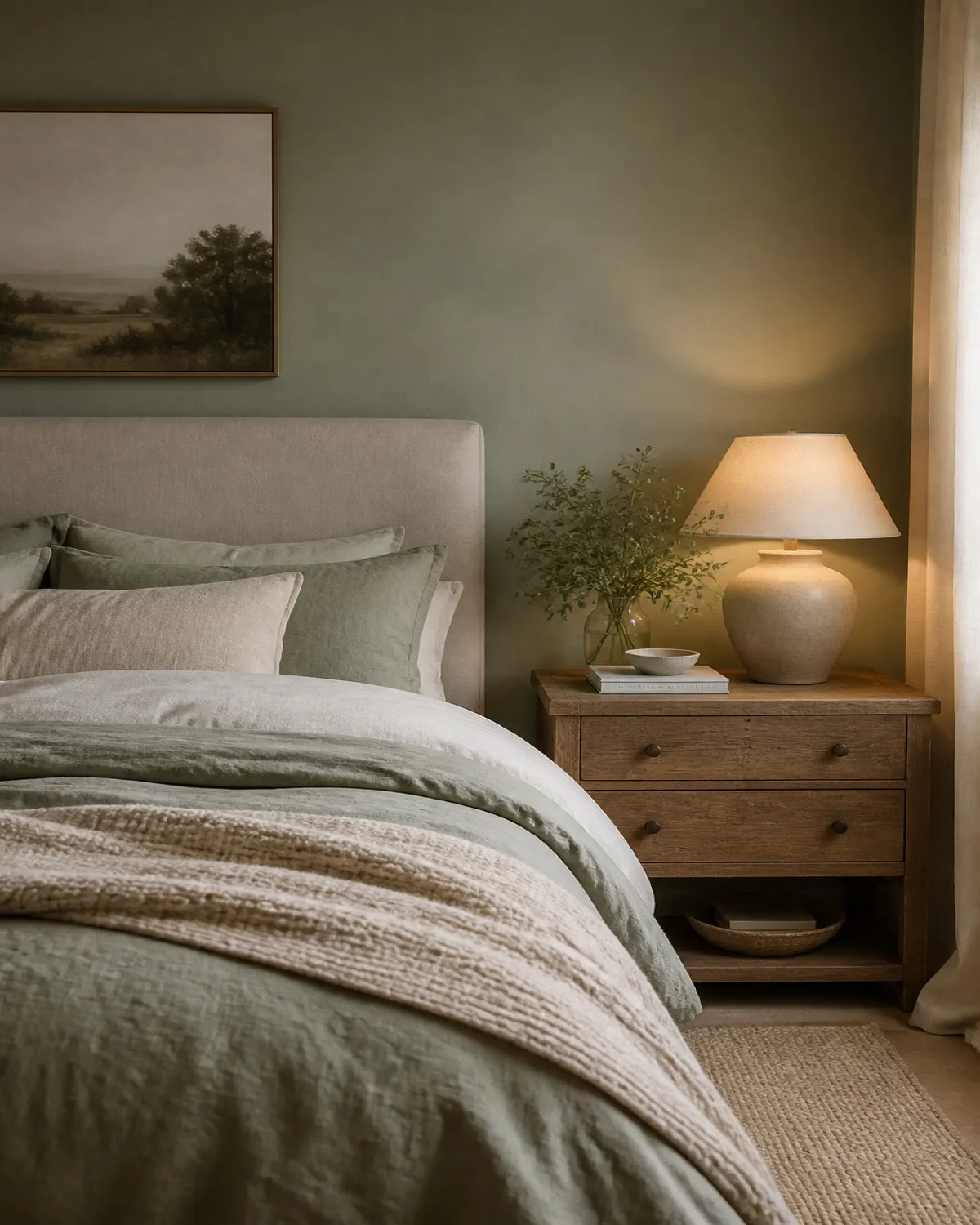
A single bright ceiling fixture flattens everything and emphasizes how small the box is. Aim for three softer sources: bedside light, a low corner lamp or wall sconce, and optional string or picture lighting for mood.
Warm bulbs (around 2700K) make surfaces look closer and kinder — essential for coziness without visual noise.
If you want to recreate this layered look, a matching pair of ceramic bedside lamps is a practical option — one on each nightstand keeps the glow even without crowding a small tabletop.
6. Try wall-mounted or swing-arm sconces
Nightstands steal precious floor and surface area. Wall sconces free the tabletop for a book and water only. Swing-arm styles adjust for reading without a bulky lamp base.
Place switches or plugs thoughtfully so cords do not crawl across the wall like afterthoughts.
7. Edit the nightstand to three objects
Clutter expands psychologically. Keep: one lamp (or sconce), one personal object, one practical item. Baskets on a lower shelf hide chargers and lotion bottles so the horizontal plane stays calm.
A compact matching pair with closed drawers makes that three-object rule easier: both sides of the bed stay balanced, the tabletops stay calm, and the rest has a place to disappear.
If you prefer a lighter wood piece with charging built in — so the phone never needs a second object on the table — a compact mid-century nightstand with drawers and an open shelf is a practical alternative.
If you want charging built into a matching black pair — slatted handles, stainless-steel feet — a set of two nightstands keeps both sides of the bed even without a second cord nest.
8. Build height with a tall, narrow dresser
Wide dressers dominate. A tall, slender chest uses vertical volume you already pay for in rent and leaves walking paths clearer. Mirror the same finish as other wood tones so the room feels collected, not showroom-scrambled.
If you have a longer unused wall — and clothing currently lives in piles — a low nine-drawer chest can replace several open bins. Keep the top as edited as the nightstand, and measure width first: this kind of piece is for a dedicated wall, not a squeeze beside the bed.
9. Use under-bed drawers as invisible storage
Seasonal clothes and extra linens belong where you do not see them daily. Low-profile under-bed drawers or fabric bins on wheels keep the visual field open. Avoid stacking random boxes that peek out and undermine the “legs and light” effect.
10. Mirror the longest sightline
A mirror should reflect light or a calm vignette — not a cluttered closet. Place it opposite a window or at the end of the bed’s axis so the room feels doubled along its strongest line.
Full-length mirrors leaned or mounted on closet doors are especially efficient in apartments.
If closet doors are not an option, a compact wall mirror still helps — as long as it reflects light or a calm corner, not clutter.
11. Soften the head wall with textile, not more furniture
An upholstered headboard, hanging tapestry, or quilted panel adds acoustic comfort and a clear “anchor” for the bed. Soft materials absorb echo in hard-walled rentals, which makes the room feel more expensive and more restful.
Keep the textile scale large; many small pillows against a tiny headboard look busy.
12. Limit the pillow landscape
Magazine beds with eight pillows look lush in a loft. In 10×11 feet, they look like storage overflow. Two sleeping pillows plus one lumbar or one textured sham is usually enough. Coziness comes from fabric quality, not quantity.
Zippered cotton protectors under those two sleeping pillows keep the layer you actually use washable — without adding more shams to the landscape.
13. Choose bedding with quiet texture, not loud pattern
Tone-on-tone linen, washed cotton, or a subtle weave photographs well and reads as intentional. Large floral or geometric prints can shrink perceived wall space. Save pattern for a single throw or the rug if you crave personality.
A queen 4-piece set in solid white is a practical quiet field: fitted sheet, flat sheet, and two pillowcases, without a large print competing with the walls. This listing is brushed polyester microfiber — easy to wash, not a linen claim — with deep pockets meant for mattresses up to around 16 inches.
For a quieter luxury approach to materials, see our quiet luxury at home style guide.
14. Float a slim bench only if circulation allows
A bench at the foot of the bed is lovely — until you have to turn sideways to pass it. If your path from door to closet is under 30 inches with the bench in place, skip it. Use a wall hook for the throw instead.
When the aisle stays clear, a slim-depth tufted bench is a practical way to finish the bed and keep the throw off the floor.
15. Create a micro “dressing ledge”
Even without a walk-in closet, a shallow shelf or wall rail near the wardrobe becomes a morning station: jewelry dish, lint roller, tomorrow’s outfit. Containing the ritual prevents the bed from becoming a clothing dump.
16. Let art breathe — one strong piece beats a collage
Gallery walls can overwhelm small bedrooms. One larger frame (or a diptych with generous margins) gives the eye a resting place. Hang art slightly higher than you think if curtains already emphasize height.
17. Keep closet doors visually quiet
Mirrored doors enlarge; solid doors in the wall color disappear; busy louvered or mismatched doors become the loudest object. If you cannot replace doors, unify them with removable film or consistent hardware finishes.
18. Zone a studio with a low bookcase, not a wall
Floor-to-ceiling dividers can create a cave. A low open bookcase or open shelving unit separates sleep from living while preserving light and sightlines. Face the prettier objects toward the living side; keep bedroom-facing shelves calmer.
19. Use scent and sound as “invisible square footage”
A linen spray, quiet fan, or consistent evening playlist cues the brain that this zone is for rest — especially important when the bedroom shares walls with a kitchen or street. Rituals enlarge the feeling of a dedicated suite even when square footage does not.
20. Match metal finishes — then stop
Mixed metals can look collected in large homes; in small bedrooms they often look accidental. Pick one primary metal for lamps, pulls, and curtain hardware. Wood and ceramic can still vary.
21. Raise the bed only if storage is worth the visual weight
Storage beds help, but bulky hydraulic bases can erase the floating effect. If you need storage, prefer drawers with inset fronts and a slim silhouette, or a traditional frame plus under-bed bins.
22. Keep pathways clear — beauty follows function
The most “designed” small bedrooms still fail if you bruise your shin nightly. Prioritize a clear route from door to bed and bed to closet. Negative space is a decorating material; treat it as carefully as paint.
23. Choose a duvet scale that fits the mattress story
Oversized European duvets pooling on the floor can look luxurious in spacious rooms and messy in tight ones. Aim for a cover that breaks softly at the sides without blocking under-bed light and legs.
24. Bring in one living element
A single plant, a branch in a tall vase, or even high-quality dried stems interrupt the rectangle of bed-dresser-window. Life softens edges. Skip a windowsill jungle that blocks daylight — light is your primary expander.
25. End every day with a five-minute reset
Cozy is a practice. Fold the throw, clear the nightstand, open or close curtains with intention, put clothes on the dressing ledge — not the chair. Small bedrooms reveal disorder faster than large ones; a short ritual protects the calm you designed.
Browse more room-by-room ideas in our bedroom and small spaces categories whenever you need a fresh edit.
Common mistakes that shrink a small bedroom
Pushing all furniture against the walls “to open the middle.” Sometimes floating the bed a few inches or angling a chair creates better circulation than a rigid perimeter.
Buying apartment-sized furniture that is still too deep. Always measure depth, not just width. A “small” sofa-style bench can still block the door arc.
Ignoring door swing and radiator clearance. Beautiful layouts die when doors cannot open fully.
Too many light sources with cool bulbs. Mixed color temperatures make surfaces look dirty and rooms feel restless.
Storing “maybe” items in the bedroom. If it is not weekly-use or sleep-related, it belongs in a hall closet, under-sofa bin in the living room, or donated. The bedroom should not be the apartment’s overflow attic.
Matching everything in a boxed set. Coordinated suites can feel hotel-generic and visually heavy. Mix one wood tone, one metal, and varied textiles instead.
FAQ
How can I make a small bedroom feel bigger without renovating?
Focus on continuous wall color, vertical curtains, a bed with visible legs, layered warm lighting, and ruthless surface editing. These changes alter perception more than most DIY builds.
What colors make a small bedroom feel cozy and larger?
Soft warm neutrals and muted nature tones — stone, oat, sage, clay — tend to work better than stark cold white or high-contrast black. Coziness comes from warmth; spaciousness comes from low contrast between walls, ceiling, and large textiles.
Is a mirror always a good idea in a small bedroom?
Yes — if it reflects light or calm. No — if it reflects clutter, laundry, or a chaotic closet. Placement matters more than size alone.
Should I use a canopy or four-poster in a tiny room?
Usually no. Vertical posts add visual posts in an already tight volume. If you love the romance, try a soft fabric panel behind the bed instead of a full canopy frame.
How do I decorate a bedroom that is also my office?
Keep work tools behind a closed cabinet or in a tote that leaves the room at night. Use a task lamp that turns off independently from sleep lighting, and avoid facing a glowing monitor toward the bed. The room needs a clear “closed for business” cue.
What is the first upgrade I should buy?
Lighting and bedding. They change atmosphere immediately and do not require landlord approval. Furniture can wait until the room’s light and textile story feel right.
Conclusion
A cozy small-apartment bedroom is not about shrinking your taste — it is about sharpening it. Height through curtains, lightness through legs and lamps, calm through edited surfaces, and comfort through honest textiles will do more than any single “space-saving gadget.”
Start with one axis: light, layout, or textiles. Finish the five-minute nightly reset. Then build slowly. The rooms that feel biggest are often the ones that simply refuse to hold anything that does not earn its place.
When you are ready for the next layer, return to our calm bedroom sanctuary guide or explore more ideas across Nestlyra’s bedroom collection.
Save for later
Pin this idea
Designed for Pinterest — tall visuals, clear titles, and room ideas you can revisit when you decorate.