15 Bedroom Lighting Ideas That Make Your Room Feel Cozy & Expensive
Bedroom lighting ideas that make a room feel cozy and expensive: layered lamps, 2700K bulbs, sconces, and a simple nighttime setup.
A single bright ceiling light is why so many bedrooms feel unfinished after dark. It flattens texture, puts the bed on a stage, and leaves corners looking like leftover space. The rooms that feel cozy and quietly expensive do something simpler: they use layers of light at different heights, warm color, and brightness you can actually turn down.
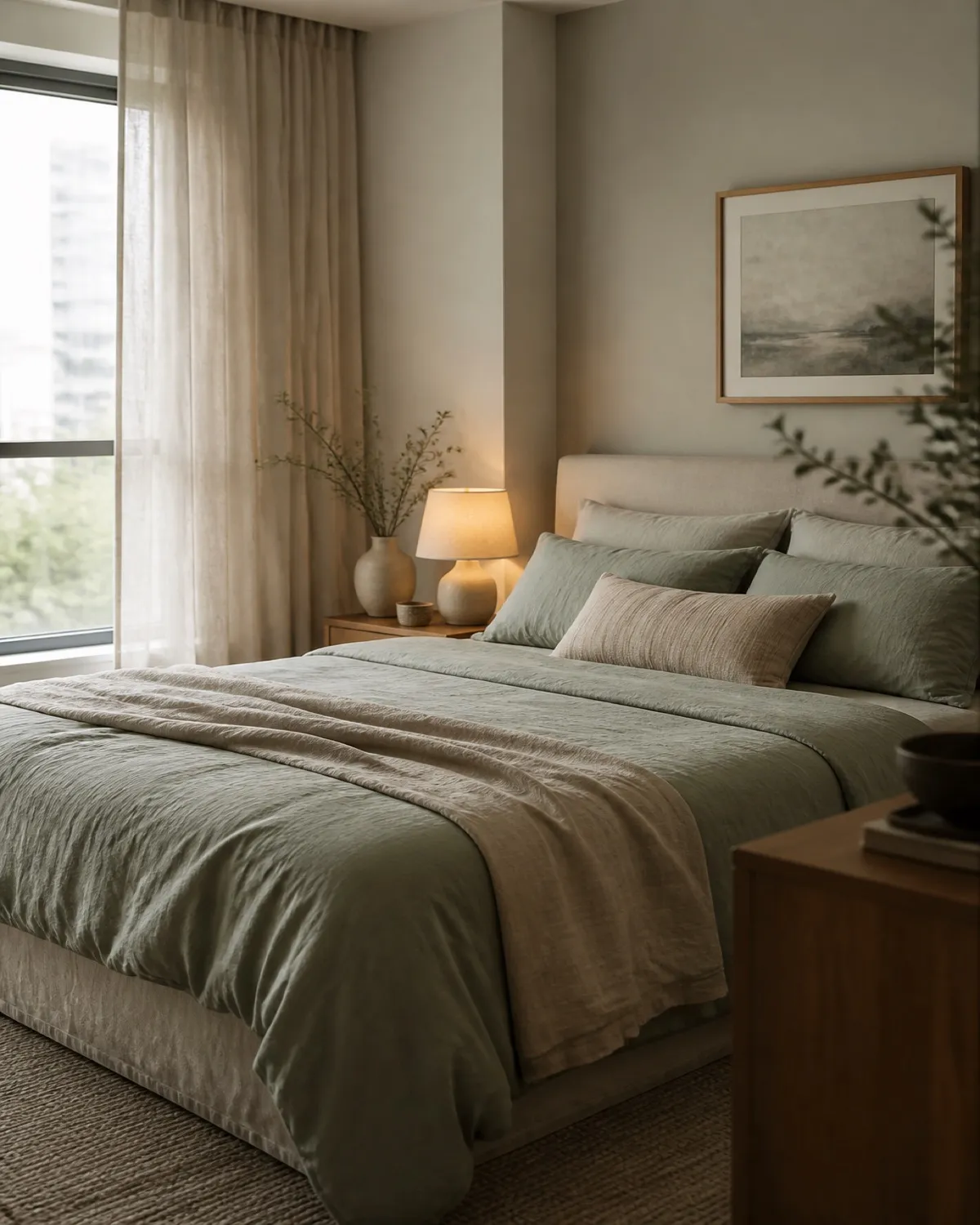
This guide is a practical set of bedroom lighting ideas for renters and owners who want the room to work at 10 p.m., not only in photos. You will learn how to combine ambient, task, and accent lighting; where bedside lamps, wall sconces, floor lamps, and ceiling fixtures belong; and which warm white bulbs (around 2700K to 3000K) keep the mood relaxing instead of clinical.
You do not need a renovation. Start with the sources you already have, then add one well-placed lamp or sconce. Pair the lighting with our calm bedroom sanctuary foundation, or with cozy bedroom ideas for small apartments if square footage is tight.
1. Layer ambient, task, and accent lighting
Overhead light alone is ambient by default, and it is usually too strong. A collected bedroom uses three jobs of light, not three copies of the same lamp.
- Ambient fills the room softly: a dimmed ceiling fixture, a paper lantern, or light bounced off a wall.
- Task is for reading, dressing, or finding something in a drawer: a bedside lamp, a swing-arm sconce, or a floor lamp with a shade.
- Accent is the jewelry: a picture light, a low glow behind a headboard, or a lamp on a dresser that keeps the far wall from disappearing.
Why it feels expensive: Hotels rarely light a room from one point in the ceiling. Multiple heights create shadow and depth, which reads as considered rather than leftover.
Where: Map the room in three zones: the bed, a corner or dresser, and one wall or art piece. Each zone gets a source you can switch independently.
When: Build this stack before you buy decorative objects. Lighting is the architecture of atmosphere. If you want a fuller rest-first plan after the lights are right, continue with how to create a calm bedroom sanctuary.
2. Switch every bulb to warm white
The fastest upgrade is not a new fixture. It is the same lamps with the right color temperature.
Stay in warm white, about 2700K, and no cooler than 3000K in a sleep room. Cool white (4000K and up) makes linens look gray and skin look tired. Mixing warm and cool bulbs in the same room is worse: the space looks slightly dirty, as if the paint never settled.
Choose dimmable LEDs so you are not stuck at full brightness. Fabric shades need enough output to read by, but the quality of the light matters more than the lumen boast on the box. Look for a high CRI (90+) if the packaging lists it; colors in bedding and wood look truer.
Why it feels cozy: Warm light shortens visual distance. Surfaces look closer, softer, and more like evening.
Best for relaxing evenings: If you change nothing else, change the bulbs in the lamps you actually use after dark. Leave a cooler bulb in a closet if you need it for finding navy from black; keep the sleep zone warm.
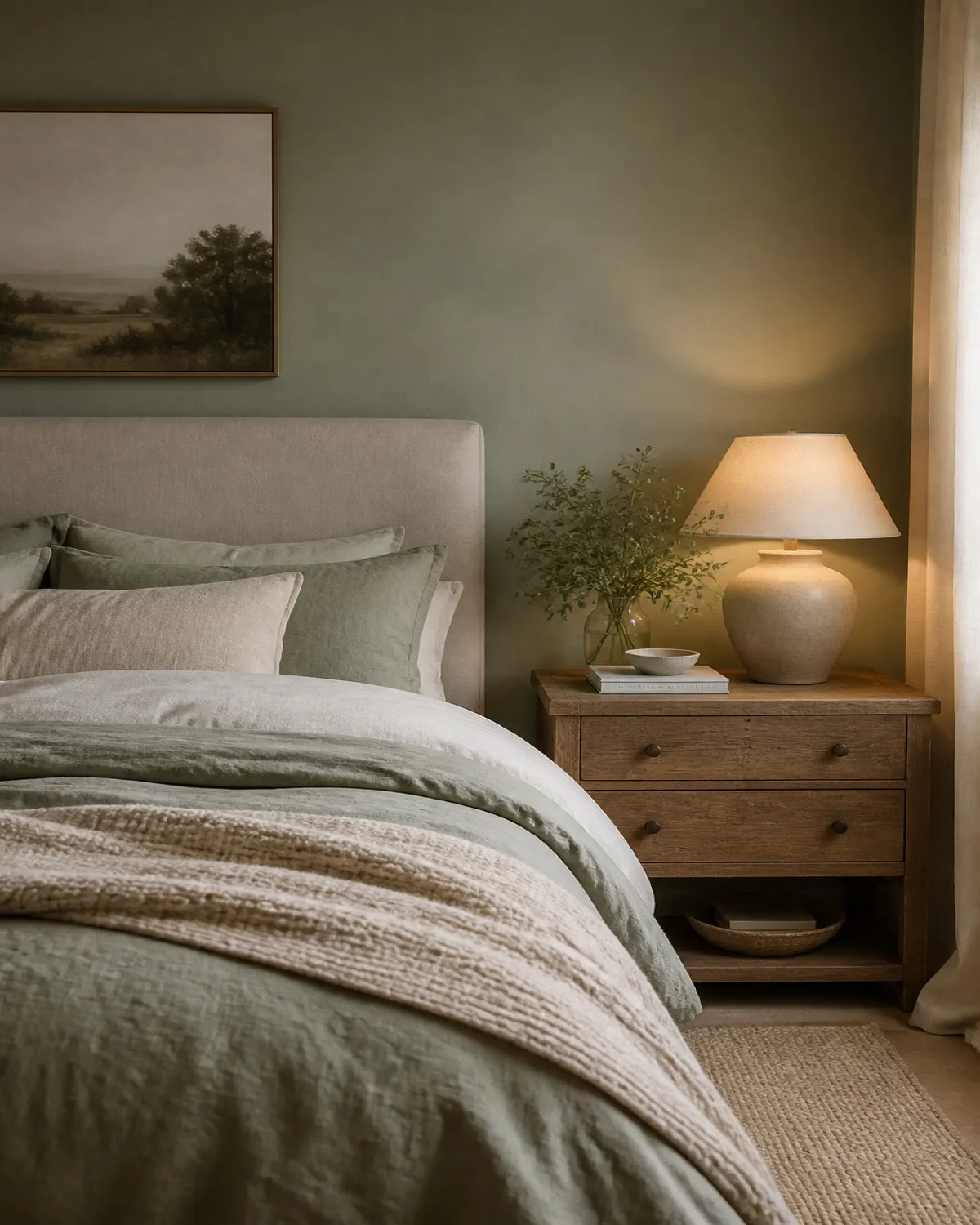
3. Use matching bedside lamps
One lamp on one nightstand looks like a compromise. A pair, even if the nightstands differ slightly, makes the bed feel like a finished composition.
Scale the lamp to the table: the shade should sit roughly at shoulder height when you are sitting up in bed, and the base should not swallow the whole surface. Ceramic, stone, or wood bases with linen or cotton shades diffuse light. Clear glass and exposed bulbs look sharper and more decorative than restful.
If you want to recreate this look, a warm-toned table lamp with a fabric shade is an easy place to start, and a matching set keeps both sides of the bed even.
If you want the same matching-pair idea in a darker ceramic, a charcoal urn base with a cream linen shade reads more transitional and still keeps the glow even on both sides of the bed.
If the nightstand is tiny, a compact wood tripod lamp with a linen shade keeps that same warm, diffused glow without crowding book and water. It also works as the extra lamp on a dresser when the bed already has a pair.
If you want the shade itself to add texture, a woven rope lamp casts a warmer, more patterned glow than a plain linen drum. That kind of light reads as considered, not as a leftover fixture.
Best for bedside tables: Look for a pair, a fabric shade, a stable base, and a switch you can reach without sitting up fully. Skip oversized statement lamps that force the water glass onto the floor.
4. Get the bedside glow at the right height
Warm light in the wrong place still feels awkward. If the shade sits too high, you get glare in the eyes. If it sits too low, the bed stays in shadow and the ceiling takes the light.
Aim for the bottom of the shade to fall near your shoulder when you are sitting against the headboard. The pool of light should land on a book in your lap, not on the opposite wall. A slightly opaque shade is kinder than a sheer one that shows a bright bulb.
On a small nightstand, choose a slimmer base or move the lamp to a wall sconce (idea 6) so the tabletop can stay at book and water. For compact layouts, this is the same editing logic we use in small-apartment cozy bedroom ideas.
Why it looks expensive: Correct height is what people notice without naming it. The room feels “done” because the light is where a body actually is.
5. Make the lighting dimmable
Full brightness is for making the bed and finding a lost earring. Night needs a lower register.
Put dimmers on ceiling fixtures if you own the electrical. For lamps, use dimmable bulbs plus a dimmer plug, a three-way socket, or a lamp with a built-in dimmer. Smart bulbs (idea 14) are the renter version of the same idea.
Keep at least one source that can go very low without shutting off. That is the light you use for the last twenty minutes before sleep.
Why it feels more expensive: Cheap rooms have two settings: on and off. Considered rooms have a middle.
When: Dim overheads first. Bedside lamps can stay a little brighter for reading, then drop after the book closes.
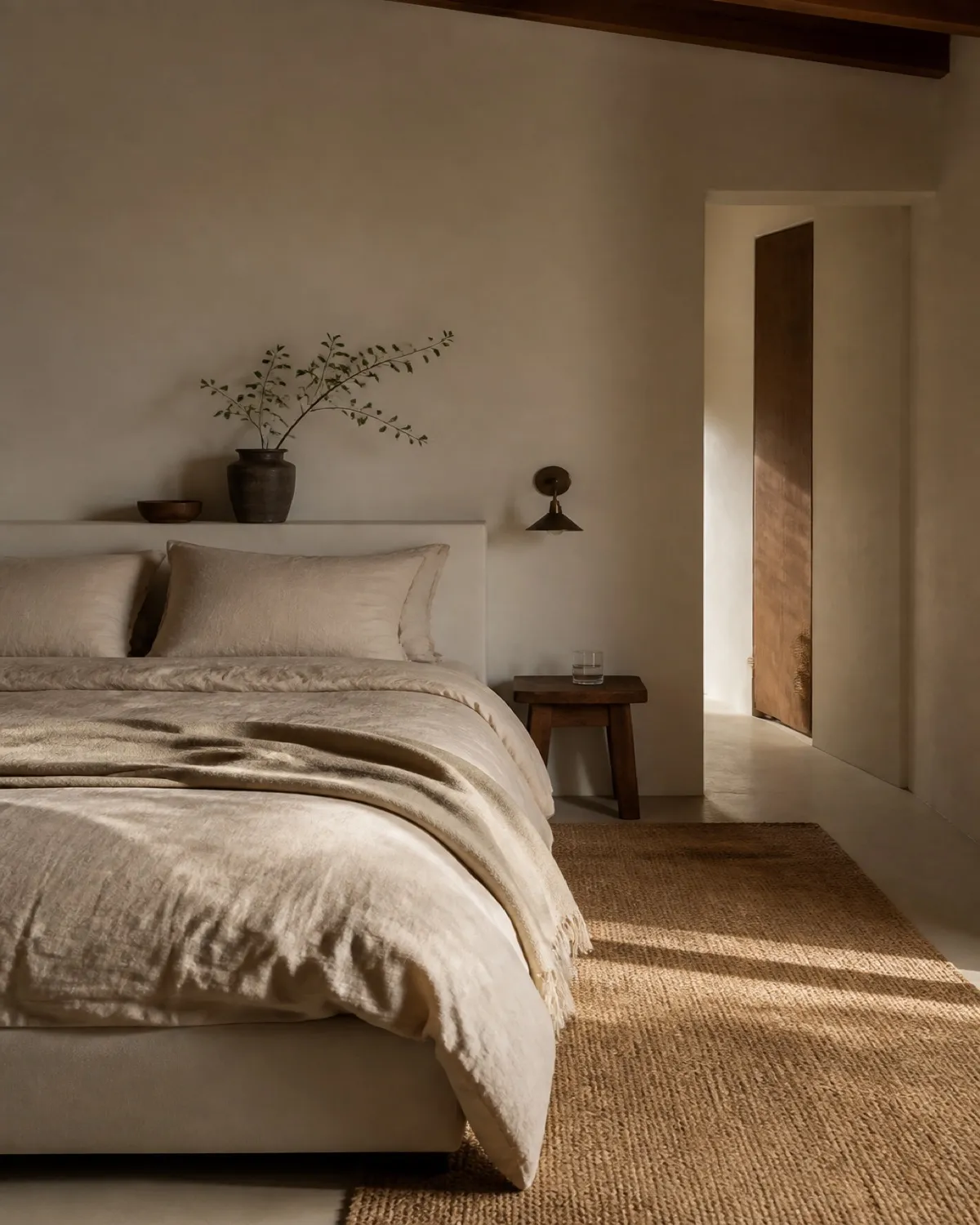
6. Add wall sconces beside the bed
Sconces free the nightstand and give the head wall a vertical line, which is useful in small bedrooms and rentals where tabletop real estate is already gone.
Best for renters: Plug-in sconces with a cord cover or a discreet drop to an outlet avoid hardwiring. Hardwired pairs look cleaner if you can add a junction box, but they are not required for the effect.
Best for small bedrooms: Swing-arm or adjustable shades let you read without a bulky lamp base. Mount them so the shade is still near shoulder height when you sit up. Leave enough clearance that you will not hit the fixture when you sit up quickly.
Match metal to other hardware in the room (one finish is enough). Fabric or frosted shades stay softer than bare bulbs.
Why it feels custom: Wall-mounted light looks planned. Table lamps can look like they arrived with the nightstand set. A sconce says someone decided where the light should live.
If you can hardwire a pair, an up-and-down wall wash is a modern alternative to a fabric shade: the light stays on the plaster, the nightstand stays clear, and both sides of the bed match. These fixtures need a standard junction box; they are not the plug-in renter option above.
7. Use pendant lights as bedside lighting
Pendants over nightstands are a more architectural version of the matching-lamp idea. They clear the tabletop completely and draw the eye up, which helps low or compact rooms.
Hang them so the bottom of the shade sits roughly where a table-lamp shade would: not in your face when you sit, not so high that the bulb becomes a ceiling spotlight. Small fabric, paper, or frosted glass shades work. Large drum pendants over a queen bed usually belong over a dining table, not a pillow.
This is harder in a rental unless you use a plug-in pendant kit. If the ceiling box is only in the center of the room, skip this idea and use sconces instead.
When it is worth it: You want a modern, gallery-like bedside and you can place two cords or two boxes symmetrically. One pendant on one side looks accidental.
8. Add a dedicated reading light
Ambient glow is not the same as a reading light. If you read in bed, you need a directional source that lights the page without lighting the whole room, especially if someone else is already asleep.
Options that work:
- A swing-arm sconce aimed at the book
- A small adjustable lamp on the nightstand, used in addition to the decorative pair
- A clamp or headboard light if the bed is against a wall with no table
A plug-in reading sconce is the renter-friendly version of that first option: the nightstand stays clear, the beam aims at the page, and a separate night-light halo can stay on after the book closes.
Keep this bulb warm too. A cool “task” LED on the page will fight every other lamp in the room. Dim the decorative lamps and let the reading light do the work; then reverse that when you put the book down.
Why it feels considered: Function is part of luxury. A room that only looks pretty but cannot be used at night never feels expensive for long.
9. Place a stylish floor lamp in a dark corner
Bedside light can leave the far corner of the room in a hole. A floor lamp near a chair, dresser, or empty corner fills that hole and gives you a second ambient source while you get dressed.
Choose a shade that throws light down and slightly out, not a torchiere that only washes the ceiling (unless the ceiling is low and you need bounce). Slim tripod or simple stem lamps take less visual weight than a bulky arc over the bed.
In a small bedroom, skip the floor lamp if it blocks the path from door to closet. Wall wash or a lamp on the dresser is the substitute. Circulation still beats a “styled” corner you have to sidestep.
The floor under that path should stay one field, not leftover mats. A 6-by-9 under the bed keeps the lamp from standing on bare boards — as long as it does not eat the walkway.
When: Use it as the middle layer of the evening: overhead off, floor lamp on while you move around the room, bedside lamps only at the end.
A wood floor lamp with a fabric shade and a small built-in tray can do that middle layer without adding a second table. Keep the color temperature on the warm setting; cooler modes belong in a work corner, not beside the bed.
10. Upgrade the ceiling fixture (or stop using it at night)
The builder-grade flush mount is often the loudest, cheapest-looking object in the room. You do not always have to replace it, but you should decide its job.
If you keep it: swap to a warm dimmable bulb, add a simple fabric or paper shade if the form allows, and treat it as daytime fill. At night, leave it off.
If you replace it: a flush or semi-flush with a linen, paper, or frosted diffuser is quieter than a crystal spray or a fan of exposed bulbs. In rooms with height, a single modest pendant can work, but keep the scale smaller than a dining fixture.
Renters: A plug-in ceiling pendant is rarely worth the visual fuss. Change the bulb, dim it, and invest in lamps you can take with you.
Why it matters: A harsh ceiling light will undo every expensive textile in the room. Softening or retiring it is how layered lighting actually sticks.
11. Use indirect lighting for a softer glow
Indirect light is light you see as a wash, not as a bulb. It is one of the most reliable ways to make a bedroom feel expensive because the source disappears and the surfaces remain.
Practical versions:
- A lamp aimed at the wall, not into the room
- LED tape tucked behind a headboard, a crown of a tall dresser, or under a floating shelf (warm white, not rainbow party colors)
- A picture light that grazes art instead of flooding it
Keep the strip or bulb hidden. If you can see dots of LED, the effect collapses. Use a diffuser channel where you can, and stay in the same 2700K family as the rest of the room.
Where: Behind the headboard in a rental (battery or plug-in strips), or on the wall opposite the bed so the glow is in front of you, not above you.
Furniture can do this job too. A nightstand with a low built-in wash gives you midnight light without turning the ceiling fixture back on, as long as you keep the color quiet and the brightness down.
12. Add soft accent lighting around furniture
Furniture should not sit in a black outline after dark. A low source at the dresser, a glow in an open nightstand cubby, or a slim lamp on a chest keeps the architecture of the room visible.
This is not an invitation to outline every object in LED. One extra pool of light on the longest unused wall is enough. If the dresser already holds a lamp for getting dressed, that lamp is your accent. Do not add a second competing color.
Why it works: The eye reads a fully dark perimeter as unfinished. A little light in the background makes the bed feel nested instead of stranded.
Small bedrooms: Prefer a lamp on existing furniture over another floor fixture. Extra bases eat circulation.
A long dresser on an unused wall is a practical place for that extra pool of light: a lamp on top for dressing, and a low glow at the base so the piece does not disappear after dark. Outlets on the dresser also keep the lamp cord from crawling back to the nightstand.
13. Light artwork or one architectural feature
A single picture light, a narrow beam on a quiet painting, or daylight bounced from a mirror is more sophisticated than a gallery of small frames with no light at all.
Place the light so it grazes the work, not so it reflects as a white rectangle in the glass. Warm bulbs keep art from looking museum-cold. If you have no art worth lighting, light the window wall with sheers by day and skip this idea rather than highlighting a cluttered closet.
A wall mirror opposite a lamp or window does related work: it doubles the glow without another fixture. That is especially useful in compact rooms. Keep the reflection calm. Lighting a mess only makes the mess brighter.
For a stricter, fewer-object version of this idea, see minimalist bedroom decor ideas.
14. Use smart bulbs for an adjustable atmosphere
Smart bulbs will not style a room by themselves. They will let you shift brightness and warmth without a hardwired dimmer, which is the point in a rental.
Set three scenes and stop collecting more:
- Day — brighter, still warm (around 2700K–3000K)
- Evening — medium, lamps only
- Night — very low bedside, everything else off
Avoid cycling through colored light as décor. A bedroom that turns blue or purple reads as a gadget, not as a restful room. Warm white, dimmable, repeatable scenes are the whole job.
When they are worth it: You cannot add dimmers, you want a phone or voice cue for the wind-down, or you share the room and need a consistent “lights down” without flipping six switches.
15. Create a relaxing nighttime lighting setup
The last idea is a sequence, not a fixture. Atmosphere is a habit.
A simple Nestlyra evening:
- Overhead off after you enter the room to stay.
- Floor lamp or dresser lamp on while you change and put things away.
- Bedside lamps only once you are in bed.
- Reading light on if you need it; other lamps dimmed.
- Reading light off; bedside at the lowest comfortable glow, or off if you sleep in the dark.
Use the same order every night. The body learns the steps faster than it learns a new chandelier. Blackout or lined curtains help the lamps do their job; street glare will overpower even a perfect 2700K bulb.
A candle warmer lamp can sit in that last step as a dimmable pool of light on a dresser or nightstand: fragrance without an open flame, and a downward glow that does not light the whole room. Keep it as one extra source, not a replacement for the bedside pair.
Scent can sit on top of this sequence, but it cannot replace layered lamps. Light is still the cue that the room has changed jobs.
Nestlyra tip: If the room still feels flat, you are missing a layer, not a louder fixture. Add a second height (corner or wall) before you buy a brighter bulb.
Bedroom lighting: what to buy first
Buy in this order. Each step still helps if you stop there.
- Bedside lamps — a matching pair with fabric shades, or plug-in sconces if the tables are tiny. This is the change you see every night.
- Warm LED bulbs — 2700K (3000K at most), dimmable, in every sleep-zone socket. This is the cheapest way to make existing fixtures look intentional.
- Dimmable control — a dimmer, dimmer plug, or smart bulb scenes so you are not stuck at full power.
- Accent lighting — one extra source: dresser lamp, picture light, or hidden warm strip. Not five.
- Floor lamp or wall sconces — whichever your circulation and walls allow. Sconces win in small rooms; a floor lamp wins if you have a dark corner and a clear path.
Skip decorative ceiling replacements until the lamps and bulbs are right. The fixture you never dim will not save the room.
FAQ
What is the best lighting for a bedroom?
Layered lighting: a dimmable ambient source, warm bedside lamps or sconces for the bed, and one additional lamp or accent so corners do not go black. Independent switches matter more than a single “nice” chandelier. Keep everything in the sleep zone in warm white.
What color temperature is best for bedroom lighting?
About 2700K. Up to 3000K still feels residential. Cooler than that starts to feel like a hallway or office. Use the same family of warmth in every lamp you see from the bed so linens and wood stay consistent.
How do I make my bedroom lighting cozy?
Turn off the overhead at night, use fabric shades, stay in warm white, and add a second source at a different height. Dim everything lower than you think you need for the last half hour. Cozy is mostly brightness, color, and shadow, not a particular furniture style.
How many lights should a bedroom have?
Three sources is a reliable baseline: two at the bed (or a pair of sconces) plus one elsewhere. A fourth can be a reading light or a picture light. More than that usually means competing brightness rather than atmosphere.
Are warm or cool lights better for bedrooms?
Warm. Cool light is useful in closets, bathrooms, and some workspaces. In a bedroom it keeps the nervous system slightly more alert and makes textiles look less rich. If you like a cleaner look, get it from pale walls and simple shades, not from a 4000K bulb.
How can I make a small bedroom look brighter?
Use light-colored shades, hang curtains high so daylight can spread, add a wall sconce or pendant so tables stay clear, and bounce light with a mirror that faces a window or a lamp. Avoid one powerful ceiling downlight; it emphasizes how small the box is. More on layout lives in our small-apartment bedroom guide.
How can I make my bedroom look expensive?
Match the lamps, hide the cords, dim the overhead, and keep one metal finish. Expensive-looking light is even, warm, and quiet. A mismatched thrift lamp with a beautiful shade can still look collected; a crystal fixture on a cool bulb rarely does.
Conclusion
A beautiful bedroom does not need expensive furniture. Warm, layered, well-placed light changes how every textile and wood tone is seen, and it is the layer you can adjust tonight.
Start with one upgrade: swap the bulbs, add a matching pair of bedside lamps, or retire the ceiling fixture after dusk. Live with that change for a week before you buy the next source. The rooms that feel quietly expensive are usually the ones that learned to turn down.
When the light is right, finish the rest of the atmosphere with calm bedroom sanctuary styling, or keep the object count low with minimalist bedroom decor ideas. Browse more room-by-room ideas in Nestlyra’s bedroom collection.
Save for later
Pin this idea
Designed for Pinterest — tall visuals, clear titles, and room ideas you can revisit when you decorate.