Small Bedroom Ideas to Maximize Space
Small bedroom ideas to maximize space — smarter layouts, vertical storage, multipurpose furniture, and editing rules.
Maximizing space in a small bedroom is less about stuffing more in — and more about deciding what the room must do every day. Sleep. Dress. Store. Pass through. When those jobs share one compact footprint, the winning strategy is ruthless clarity: fewer objects, better placement, and storage that disappears into the architecture of the room.
Unlike “make it look bigger” advice, this article is about function: how many steps you take without pivoting, how quickly surfaces stay clear, and whether storage opens without blocking the bed. Beautiful rooms that fight you every morning are not maximizing space — they are maximizing friction.
This guide focuses on usable square footage — walking paths, closed storage, and surfaces that stay empty on purpose. For atmosphere and coziness, pair it with our 25 cozy bedroom ideas for small apartments. For restful styling fundamentals, see how to create a calm bedroom sanctuary.
Start with a space audit (before you buy anything)
Walk the room with a tape measure and a phone photo. Note:
- Door swing and closet clearance
- Window and radiator keep-out zones
- The primary path from door → bed → closet
- Everything currently stored that is not weekly-use
Anything seasonal, sentimental, or “maybe later” is stealing sleep space. Relocate it before you shop for organizers. Space you free with editing is free forever; furniture only rearranges the problem.
Layout ideas that reclaim floor area
1. Put the bed on the longest solid wall
Centering a bed under a window looks romantic in catalogs. In tiny rooms, it often wastes the strongest wall and complicates curtains and nightstands. A long uninterrupted wall usually supports a cleaner axis and wider side clearances.
2. Leave at least one full side open
Two squeezed nightstands create a bed that feels trapped. If the room is very narrow, keep one proper nightstand and use a wall shelf or sconce on the other side. One generous path beats two pinched ones.
3. Float only what you can afford
“Floating” furniture away from walls works when leftover perimeter still allows passage. If floating the bed leaves less than ~24 inches to walk, keep it closer to the wall and invest in under-bed storage instead.
4. Align furniture edges into one line
Misaligned dresser, chair, and laundry basket create visual and physical zigzagging. Line fronts up as much as possible so circulation becomes a straight corridor rather than an obstacle course.
5. Treat the door arc as sacred negative space
Never place a hamper, plant, or bench inside the door’s full swing. That invisible wedge of floor is part of your usable space — protect it.
One generously sized rug can still unify the bed without eating that wedge. A 6-by-9 works when the bed sits on it with a little margin and the door arc stays clear — not when the rug becomes another obstacle.
Vertical storage that actually works
6. Go tall before you go wide
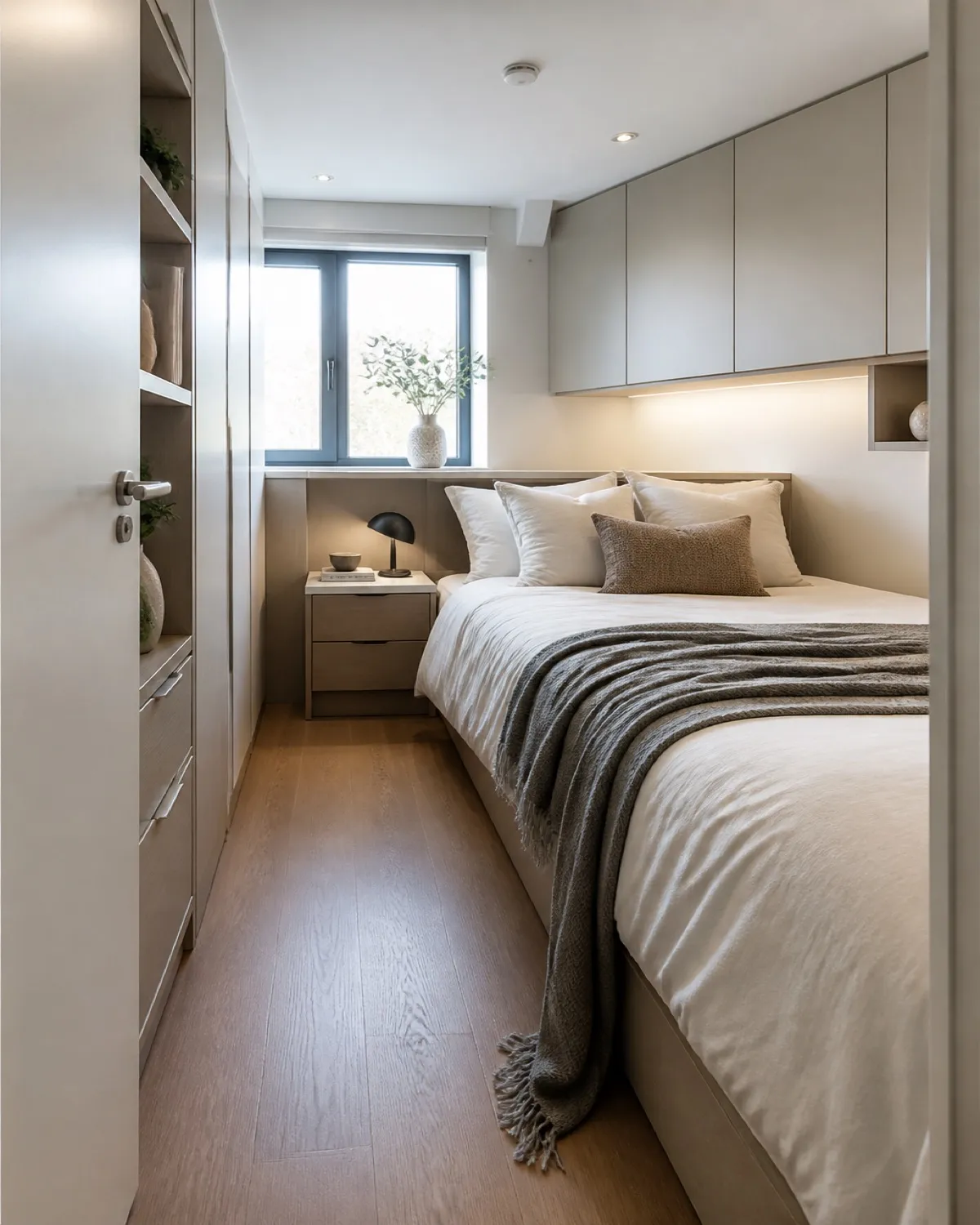
Width consumes walking lanes; height uses air you already rent. Prefer a tall chest over a low double dresser when both offer similar capacity.
If your ceiling is high enough, consider a single tall unit rather than two shorter pieces side by side. One footprint, one visual mass, one dusting surface — and a clearer path around the bed.
7. Use the wall above the headboard carefully
A single shelf for books is useful; a crowded ledge becomes dust and visual noise. Keep objects sparse and below the height where you might hit them sitting up.
A practical test: sit up in bed and raise both arms. Anything within that zone should be soft, fixed, or absent.
8. Exploit the closet’s vertical thirds
Think in three bands: daily clothes at eye level, weekly items mid, seasonal up high in labeled bins. Empty hangers and one-off garments are silent space thieves — edit monthly.
9. Add a shallow ledge, not a deep shelf, by the door
Keys, sunglasses, and a lint roller belong on a 4–6 inch ledge or rail. Deep shelves invite piles that creep into the room.
10. Mount what used to sit on the floor
Jewelry trays, mirrors, and reading lights can leave the dresser and nightstand. Every liberated surface is another place that can stay clear.
For systems thinking beyond the bedroom, our quiet organization guide covers zones and containers that keep visual noise down.
Furniture choices that earn their footprint
11. Measure depth first
Apartment shoppers obsess over width. Depth is what steals aisle space. A “small” piece that is 22 inches deep may still choke a 9-foot-wide room.
A nightstand around 16 inches deep leaves more aisle than a 22-inch cube. This black pair is 15.7 inches deep, with two drawers and a charging strip on each table so extras do not migrate onto the top.
12. Prefer drawers over open cubes in the bedroom
Open cubbies display mess. Drawers hide it. In a room designed for rest, closed fronts are kinder — and they photograph cleaner.
13. Choose a bed that stores without looking like a vault
Look for slim drawer bases or clearance for low bins. Avoid bulky lift mechanisms that raise the mattress height into a platform that dominates the room’s silhouette.
14. Skip the accent chair unless it is daily-use
The “bedroom chair” is often a clothing magnet. If you do not sit there to read weekly, replace it with a wall hook and a slim valet rail.
15. Use nesting or foldable extras only if they leave the room
A foldable drying rack or extra seat that lives in a closet is useful. One that permanently occupies the corner is not maximizing space — it is parking inventory.
Multipurpose moves for studio and micro bedrooms
16. Let the dresser double as a media / vanity ledge
One composed tray for jewelry or a small mirror converts morning chaos into a station — without adding a second table.
17. Divide studios with low storage, not a full wall
A low bookcase or open shelving unit can separate sleep from living while keeping light and air. Face calmer objects toward the bed side; keep the living side more social.
18. Keep work tools in a leave-the-room tote
If the bedroom is also the office, tools should exit at night. A single tote or closed cabinet creates a hard stop between focus and sleep — critical when square footage cannot give you a door between roles.
19. Share storage with the hall when possible
Vacuum, luggage, and bulk toiletries do not need bedroom residency. Every item you relocate to a hall closet returns floor and dresser volume to sleep.
Editing rules that permanently expand the room
20. Cap nightstand objects at three
Lamp (or sconce), water, one personal object. Everything else is drawer-bound. This single rule prevents the “landfill nightstand” that makes rooms feel smaller overnight.
21. One laundry strategy, not two
A lidded hamper or a behind-door bag — not both plus a chair pile. Decide the system and defend it.
22. Rotate seasonal textiles out of the room
Extra quilts and pillow covers belong in vacuum bags or hall storage. The bed needs what you use this month, not the year.
Zippered cotton protectors can stay on the two sleeping pillows year-round while decorative shams rotate out. That keeps the bed small without leaving pillows uncovered.
23. Photograph the room weekly for two weeks
The camera reveals piles your eyes normalize. If something appears in three photos in a row and is not furniture, it needs a home or an exit.
Lighting and color as space tools
24. Keep large surfaces low-contrast
When walls, curtains, and bedding sit in a related value range, corners soften and the room reads larger. Save contrast for a single object — a lamp base, a frame — not for every plane.
A queen 4-piece in solid white keeps the largest textile in the same value as pale walls, without mixing leftover prints. Extra unmatched sheets can leave the room.
25. Light the perimeter, not only the ceiling
Wall wash and bedside glow reduce cave shadows in corners. Dark corners make rooms feel truncated; even lighting makes walls feel farther apart.
Explore more compact-home thinking in our small spaces category, or browse restful layouts under bedroom.
Common mistakes that waste space
Buying organizers before editing. Beautiful bins filled with unused items are still clutter with better packaging.
Matching furniture sets. Suites often force redundant pieces (bench + chair + oversized dresser) that a measured plan would never choose.
Ignoring vertical dead zones in the closet. Stacking shoes in a heap while the top shelf stays empty is not a space problem — it is a system problem.
Using the bed as a horizontal closet. Folding clothes on the duvet every morning teaches the room that surfaces are temporary storage. Break the habit with a dedicated ledge or hooks.
Over-partitioning a studio. Tall screens can create two tiny rooms that both feel worse. Prefer low, porous dividers.
FAQ
What is the fastest way to maximize space in a small bedroom?
Remove non-weekly items, clear door-swing zones, and empty surfaces. Most rooms gain usable space in an afternoon without new furniture.
Is a storage bed worth it?
Yes if drawers are slim and the height still allows a light, walkable feel. No if the base becomes a visual bunker. Measure mattress height against window sills and head clearance when sitting up.
How much walking space do I need beside the bed?
Aim for at least 24 inches on the primary side; 30 inches feels more comfortable. If you cannot achieve both sides, prioritize one generous side over two tight ones.
Can I maximize space and still make the room cozy?
Absolutely. Coziness comes from textiles, warm light, and calm surfaces — not from filling every inch. Space-maximizing and cozy design reinforce each other when storage is closed and paths are clear. See our cozy small-apartment bedroom ideas for the comfort layer.
Should I use floating shelves everywhere?
Use them sparingly. Shelves that collect objects recreate floor clutter at eye level. Prefer closed storage for daily mess and open shelves only for a few intentional pieces.
What furniture should I buy first for a tiny bedroom?
A well-scaled bed and a tall closed dresser. Lighting and wall mounting come next. Decorative extras come last — if at all.
Conclusion
Maximizing space in a small bedroom is an editorial act: measure, edit, then place only what earns its footprint. Vertical closed storage, protected circulation, and furniture chosen for depth — not just style — will expand how the room works more than any single gadget.
Start with the audit. Clear the door. Empty the nightstand. Then decide whether you truly need another piece — or simply a better home for what you already own. The most spacious small bedrooms rarely look full of clever products; they look quietly finished, because nothing temporary was allowed to become permanent.
When you want the mood and softness layer next, return to 25 cozy bedroom ideas for small apartments or continue through Nestlyra’s small spaces collection.
Save for later
Pin this idea
Designed for Pinterest — tall visuals, clear titles, and room ideas you can revisit when you decorate.